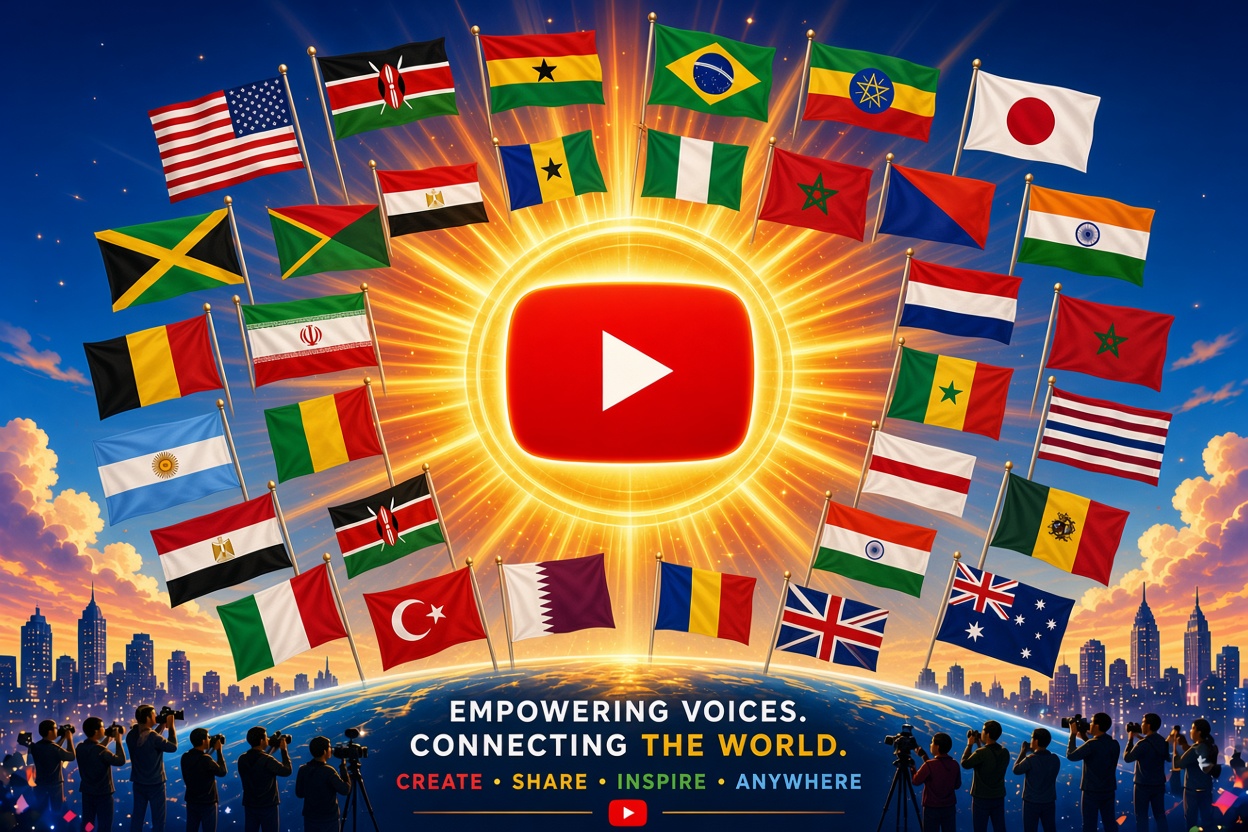
The Algorithm Belongs to Us Now
YouTube has become the most powerful cultural redistribution engine on the planet, and everybody is finally getting their turn at the mic.
Forget the museums. Forget the textbooks with half the pages torn out. Forget the gatekeepers in the glass towers who decided for decades what was worth preserving, what was worth broadcasting, and whose story deserved the primetime slot. YouTube — chaotic, democratic, occasionally unhinged YouTube — has quietly become the single most important archive of human cultural reclamation alive today. And if you are not losing hours to it, you are not paying attention.
We will confess it freely: we are guilty of watching more than our full. A documentary on the Songhai Empire at 2 a.m. A deep-cut channel out of Guangzhou breaking down Tang Dynasty fashion with the energy of a sneaker unboxing. A Jamaican historian in Kingston delivering lectures that would make any Ivy League professor pack up their slides and go home. The content is relentless, it is brilliant, and it is arriving from every timezone at once. This is not content consumption. This is a civilizational correction happening in real time.
 Clear Nights Smooth Finish
China is telling its own story with production budgets and national pride that demand your respect. South Korea was already winning that war. Nigeria is flooding the platform with Nollywood legacy content, Afrobeats origin stories, and cultural commentary so sharp it cuts. South Africa is excavating its pre-colonial depth and post-apartheid complexity simultaneously. Jamaica — always punching ten weight classes above its geography — is reminding the world that an island of three million people rewired the entire planet's relationship to rhythm, resistance, and style. These are not fringe uploads. These are nations reclaiming their own narrative and distributing it to billions without asking anyone's permission.
And then there is Black America. The community that built the dominant global culture while being systematically denied the pen to write its own history has found something extraordinary in the absence of a gatekeeper. African American creators, historians, architects, chefs, designers, and griots are uploading a counter-archive that is staggering in its scope and emotional force. No network executive. No editorial board. No distribution deal required. The algorithm does not care about your redlining history. The upload button is the great equalizer, and Black America is using it with the urgency of people who understand exactly what was stolen and exactly what it means to take it back.
What YouTube has created — probably without fully intending to — is the most radical redistribution of cultural authority in recorded history. Every nation, every community, every lineage that was told its story was not important enough for the main stage now has a stage with a global audience and no cover charge. The implications for identity, for education, for the way future generations understand who they are and where they come from, are almost too large to calculate. This is not nostalgia. This is revalidation. This is the world finally getting the full picture.
The culture has always been richer, deeper, and more complex than the old gatekeepers allowed us to see. YouTube did not create that richness. It just refused to hide it anymore. So yes, we will keep watching more than our full. Because what is being broadcast right now — from Lagos to Los Angeles, from Beijing to Kingston — is nothing less than humanity finally introducing itself, on its own terms, to itself.


