Clarks Forever: How Jamaica Made a British Shoe a Global Religion
From the dusty yards of Kingston to the runways of Tokyo, the rude boy culture of Jamaica turned a quiet English cobbler into a billion-dollar icon.
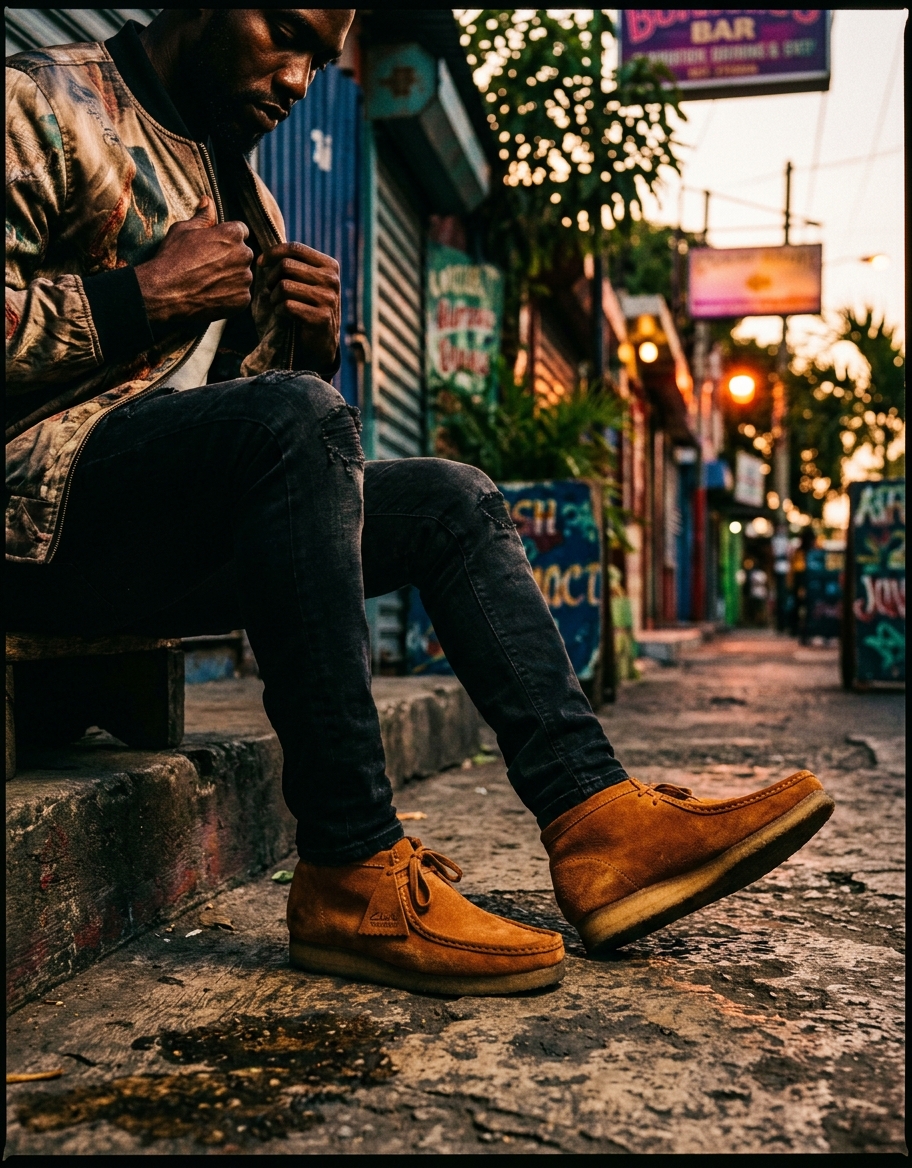
Long before any marketing executive dreamed up a campaign, the people of Jamaica did what they have always done — they took something ordinary and made it extraordinary. Clarks Wallabees and Desert Boots arrived on the island sometime in the 1960s and 70s, filtering through the hands of traders, sound system men, and sharp-dressed rude boys who understood instinctively that the soft crepe sole and the clean suede silhouette said something words could not. They were not cheap. That was the point. To lace up a fresh pair of Clarks in Kingston was a declaration — that you had taste, that you had ambition, that you moved different from the man standing next to you. The shoe became currency, status, and identity wrapped in one seamless, dusty-toed package.
The culture spoke and the music answered. Dancehall and reggae artists transformed Clarks from footwear into folklore. Vybz Kartel, the undisputed voice of a generation, made the brand a full-blown cultural manifesto with tracks that sent global demand surging in ways the Somerset-based company could barely comprehend. Beres Hammond, operating in a different register — smoother, more soulful — draped the shoe in a kind of dignified cool that crossed generational lines entirely. These were not endorsement deals engineered in boardrooms. This was organic devotion, the kind money genuinely cannot buy. When a Jamaican artist mentions Clarks on a riddim, it lands as authentication, as scripture. The streets cosigned long before the song ever dropped.
What Jamaica built was not a trend. It was a transfer of ownership — cultural ownership — that rewrote the entire legacy of a 200-year-old British brand. The rude boy aesthetic, rooted in defiance, in looking immaculate when the system gave you nothing, radiated outward through the diaspora. London, New York, Toronto, Kingston to Brixton to Brooklyn — everywhere the community moved, the Clarks moved with them. Hip-hop picked up the thread next, and suddenly Wu-Tang was referencing Wallabees, and the loop between Jamaica and the global street culture conversation closed tight. Clarks' billion-dollar valuation today has a Jamaican heartbeat underneath it, whether the ledgers say so or not.
This is what happens when culture leads and commerce follows. No algorithm predicted it. No focus group sanctioned it. A people with an unmatched gift for style, sound, and swagger looked at a desert boot and saw themselves reflected back in it — and then broadcast that reflection to the entire world. The humble origins are the whole story. A shoe built for English weather, reimagined under Caribbean sun, carried forward on basslines heavy enough to rattle your chest. Clarks will keep selling. The music will keep playing. And Jamaica, as always, will keep setting the standard for how the world decides what cool actually is.