Left-Handed Lightning: The Untamed Genius of Jimi Hendrix
He flipped the guitar upside down, rewired the rules, and burned a path through music history that no one has come close to matching.
Before Seattle claimed him as a native son and London crowned him a god, Jimi Hendrix was shaped by the North — by the cold, restless energy of a childhood that moved between worlds and never quite settled anywhere comfortable. His father Al Hendrix carried strong Canadian roots, with family ties stretching into British Columbia, and that transient, border-crossing upbringing left young James Marshall Hendrix with something powerful: the outsider's eye. He never fully belonged to one place, one sound, or one way of doing things. That displacement became his greatest weapon.
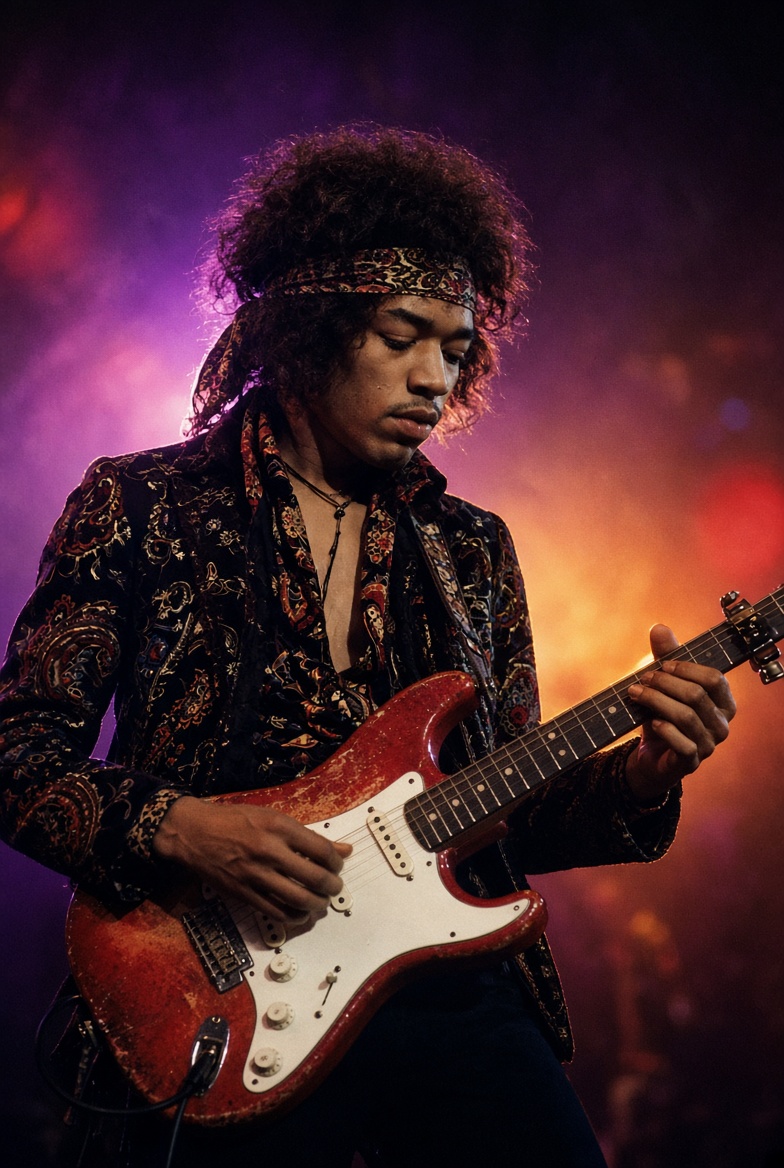
The guitar was supposed to work a certain way. Six strings, standard tuning, right hand strumming down. Hendrix looked at that blueprint and laughed. As a natural left-hander forced to navigate a right-handed world, he took a right-handed Fender Stratocaster, flipped it completely upside down, and restrung it to accommodate his dominant hand. What resulted was not a compromise — it was an accident of genius. The inverted tremolo arm, the repositioned controls, the altered string tension all contributed to a tonal palette that no other player could fully replicate, even when they tried to copy him note for note.
 Hip Vodka Island life
Hendrix did not play the guitar. He had a conversation with it — loud, violent, tender, and cosmic all at once. He coaxed feedback like it was a second voice. He used the tremolo bar to bend reality itself. Tracks like "Voodoo Child (Slight Return)," "Machine Gun," and "All Along the Watchtower" were not just songs — they were atmospheric events, sonic weather systems that rolled in and changed everything they touched. His 1969 Woodstock performance of the Star-Spangled Banner remains one of the most politically charged instrumental moments in the history of recorded sound. No words needed. The guitar said everything.
The Canadian thread in Hendrix's story runs deeper than bloodline geography. There is something in that particular brand of North American restlessness — caught between American ambition and something quieter, wilder, less defined — that echoes through his entire artistic identity. He was never the loudest personality in a room until he plugged in. He was humble offstage, volcanic on it. That duality, that tension between stillness and eruption, is the core of his legacy and the reason generations of guitarists still spend lifetimes chasing a sound he invented by accident on a flipped-over second-hand instrument.
Fifty-plus years after his death in September 1970 at just 27 years old, Hendrix remains uncatchable. The music industry has produced technical virtuosos, showmen, innovators, and icons — but nobody has closed the gap. He existed in a category of one, a man who needed the instrument to physically conform to him because the standard version of reality was never going to be enough. He did not tame the guitar. He entered into a wild, mutual agreement with it — and the world has been living inside that agreement ever since.